



Success Stories of Indian Cricketers from Small Towns
26 June 2026
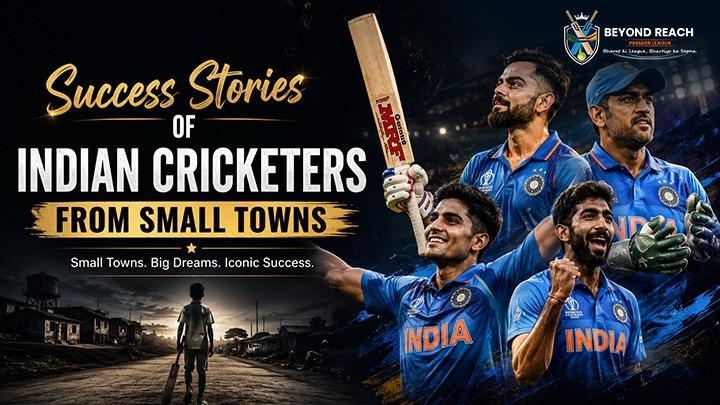
You can find cricket talent in every lane, in every open ground, and in every college campus across India, not just in the metro city.
There is something very poetic and impressive about the journey of a boy from a small Indian town picking up a cricket bat, dreaming of wearing the blue jersey, and actually making it to our national team. The best thing about them is that they don’t have fancy academies, no big-city selectors behind them. They succeed simply because of their raw talent, their burning ambition and a refusal to be defined by geography.
There are many such stories of small-town cricketers in the history of cricket in India. These stories show that the next great Indian cricketer could be playing tennis ball cricket in some small village today, waiting for that one chance that will change everything.
How Small-Town Cricketers Changed Indian Cricket
For decades, Indian cricket was largely dominated by players from Mumbai, Delhi and a handful of other big cities. These cities had the infrastructure ready with established clubs, domestic tournaments and proper coaching facilities. Most importantly, these cities are very accessible to selectors.
But there’s been a silent revolution happening. Players from Ranchi, Amroha, Ahmedabad and other neglected corners of India have not just made it to the national team, they have defined it. They brought hunger, resilience and a raw brilliance no coaching manual can teach.
Today, the Indian small-town cricketer’s story is being rewritten. Their journeys are a reminder that talent, when combined with perseverance, eventually finds its way to the top.
MS Dhoni's Journey from Ranchi to World Cup Glory
If there is one story that encapsulates the dream of every small-town cricketer in India, it belongs to Mahendra Singh Dhoni.
Early Struggles
Dhoni was raised in Ranchi, the capital of Jharkhand. He was a cricketer from a small town, playing at local grounds and a better-known football goalkeeper before cricket stole his heart. He was born into a modest family; there were no elite coaches or well-connected mentors to fast-track his journey.
To sustain himself, he started working as a Train Ticket Examiner (TTE) in Kharagpur Railway Station. Meanwhile, his peers from bigger cities were already playing in well-organized domestic setups. Dhoni would travel in a train compartment, holding his cricket kit in both hands, with dreams in his eyes.
Domestic Cricket
Dhoni's performances for Bihar and later Jharkhand in domestic cricket were eye-catching, but it still took time for the selectors to notice someone from outside the traditional cricketing belt. He got his first major chance in professional cricket at 23, which was older than the age at which most future Indian captains typically get their breakthrough.
International Success
What follows is history that every Indian knows by heart. Dhoni captained India to victory in the 2007 ICC T20 World Cup, the 2011 ODI World Cup, and the 2013 Champions Trophy. He became the only captain in the world to win all three major ICC trophies. The boy from Ranchi became the most celebrated finisher in the history of the game.
His journey shows every small-town cricketer that while the road may be longer and tougher, the dream remains within reach.
Mohammed Shami's Rise from Amroha
Mohammed Shami's story is one of a very influential grit wrapped in family sacrifice and sheer fast-bowling brilliance.
Family Support
Shami was born in Amroha, a small town in Uttar Pradesh. His father's name was Tousif Ali, who was a farmer. He was the first to recognise his son's passion for cricket, and he did everything in his power to nurture it. In a household where resources were limited, it was very difficult for his father to support his dream.
Fast Bowling Journey
Shami moved to Moradabad and later to Kolkata to pursue professional cricket. His early years were spent learning the craft of balling. Since he was not exposed to quality coaching, he himself refined his natural ability to swing the ball through practice and determination. Later, he developed one of the most classical fast-bowling actions in Indian cricket.
National Team Breakthrough
Shami made his Test debut in 2013 and has since become one of India's finest pace bowlers across all formats. His skill was developed away from the spotlight in Amroha's fields and Kolkata's club grounds. He is recognised by his ability to bowl yorkers in unfavourable conditions. His ball challenges the world's top batsmen. He proved that a small-town kid from UP can carry a nation's hopes on his shoulders.
Jasprit Bumrah's Story of Determination
Jasprit Bumrah may now be the most feared fast bowler on the planet, and his story is as unconventional as his bowling action.
Unconventional Bowling Action
Bumrah was born in a poor family in Ahmedabad. He lost his father at a young age, and his mother was a school principal who raised him with discipline and belief. His way of bowling, which starts with a short run-up followed by a whippy, chest-on delivery, was very different from the standard format. Therefore, many people doubted whether he would make it to the highest level or not, but eventually he did.
Domestic Cricket Journey
Bumrah also caught the eyes of selectors while playing for Gujarat in domestic cricket. Later in the IPL for the Mumbai Indians, his performance was hard to ignore, and now he is an important part of our national cricket team. His ability to bowl difficult yorkers is the skill that most fast bowlers spend entire careers trying to master. His art of balling made him impossible to ignore.
Becoming India's Pace Leader
Today, our Indian cricket team has Bumrah, who is ranked among the top bowlers in all three formats. He is one the rarest indian pacer who is as spectacular in Test as he is in T20s. He is someone who has dismantled batting line-ups across England, Australia, and South Africa.
His performance on the ground is a reminder that sometimes unconventional backgrounds can also bring great success.
Common Traits Shared by Successful Cricketers
Across these small-town cricketers' stories, a handful of characteristics emerge consistently — and none of them has anything to do with where a player was born.
- Discipline: Even without professional support systems, Dhoni, Shami, and Bumrah remained committed to intense fitness training and regular practice, proving that dedication comes before opportunity.
- Consistency: They performed repeatedly at the domestic level until selection became inevitable, not a favour.
- Hard Work: Besides talent, their ethics towards cricket were equally important.
- Learning Mindset: Each of them remained curious, who always wanted to refine their craft rather than stay the same.
These traits are not exclusive to stars. They are available to every young cricketer willing to commit to them.
Challenges Faced by Small-Town Players
- Limited Exposure: Small-town players rarely get opportunities to play against opposition that is well-trained. And without healthy competition, talent can stagnate or go unnoticed.
- Lack of Selector Access: Cricket in India has historically functioned on relationships and networks. A talented boy from a remote district may never play in front of the right eyes, not because he isn't good enough, but because no one with influence has seen him.
- Financial Barriers: Cricket equipment of good quality, coaching fees, and travelling for trials all of it costs money that many small-town families simply can not afford.
These are not small hurdles for thousands of aspiring cricketers. There are significant barriers that end the cricketing stories of thousands of deserving players every year.
How Platforms Like BRPL Help Emerging Talent
This is precisely why structured opportunities like Beyond Reach Premier League (BRPL) Trials matter so deeply to the ecosystem of cricket development in India.
BRPL registration is open to players who may have never had formal exposure — those who've been playing tennis ball cricket in their localities, showing ability and hunger but lacking a pathway to showcase it professionally. BRPL cricket trials in India are designed to bridge that gap: to give the boy from the small town the same shot as someone from a metro city.
Cricket trials India events like BRPL create a level playing field — where talent is the only currency. For a young fast bowler from a UP village or an aggressive batsman from a Jharkhand town, a legitimate cricket trial isn't just an opportunity. It's a life-changing moment.
Platforms like these serve as the missing link between raw, unpolished talent and professional recognition. They are, in many ways, what might have helped hundreds of players like Dhoni, Shami, and Bumrah even faster — if such structured pathways had existed earlier.
Conclusion
The stories of Dhoni, Shami, and Bumrah are not anomalies. They are proof of a truth Indian cricket is only beginning to fully embrace: talent is distributed equally across this country. Opportunity is not.
Every time a structured platform opens its doors to small-town cricketers — through accessible trials, transparent selection, and genuine pathways — India's cricketing depth becomes stronger. The next MS Dhoni may already be standing in a field somewhere in rural India, ready. The question is whether the system is ready to receive him.
If you're a young cricketer who has passion and ambition for cricket, then you should not wait for someone to discover you. You can simply seek out BRPL registration, attend cricket trials India events near you, and put your talent in front of the right people. Because the one thing that separates a dreamer and an achiever is that first brave step into the arena.
Frequently Asked Questions
Do you need to be from a big city to play professional cricket in India?
Not at all. Dhoni, Shami, and Bumrah all came from small towns. Talent beats location every time.
At what age should a cricketer start taking BRPL trials seriously?
Between 14 and 22 is ideal for giving the BRPL trial.
Is tennis ball cricket a good starting point?
Absolutely, Most successful Indian cricketers started with a tennis ball. It builds instincts and love for the game naturally.
How important is a coach for a small-town cricketer?
Helpful, but not everything. Self-discipline and a learning mindset matter far more in the early years.
What is BRPL, and how can it help emerging players?
BRPL gives unrecognised talent a structured platform for small-town players to perform and get noticed.