



The Complete Journey from Gully Cricket to Professional Cricket
10 July 2026
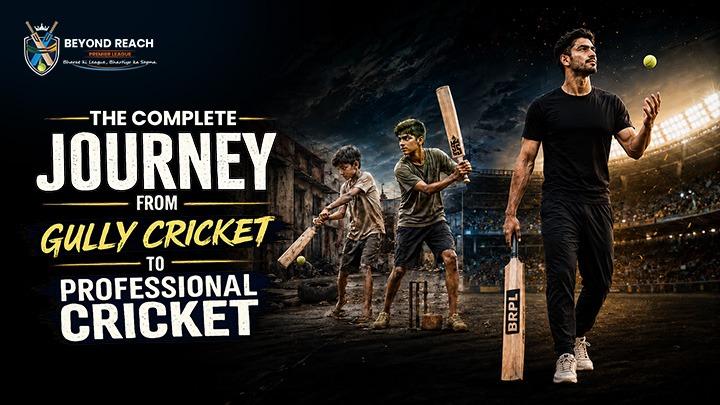
Every professional cricketer starts somewhere. For most players in India, that somewhere is a narrow street, a colony ground, or a park wall with chalk stumps drawn on it. That is gully cricket, and it is where most big journeys quietly begin.
If you have played those matches and asked yourself whether this could go somewhere, the answer is yes. Cricket in India has opened up at every level, and real pathways exist for players who did not come through fancy academies. This blog takes you through each stage of that journey.
Learning Cricket in Streets and Local Grounds
People who have never played gully cricket will never fully understand what it teaches. Tight spaces force shot control. Uneven surfaces teach you to read the ball differently every delivery. And when you are fielding three feet from the bat, your reflexes have no choice but to sharpen up.
The things gully cricket builds in you, reading the game quickly, competing without coaching, making fast decisions under pressure, these are not small things. A lot of players who go on to compete seriously will tell you that gully cricket is where they actually learned to love the game.
Joining Local Clubs and Tournaments
Once you feel serious about cricket, joining a local club or playing in mohalla tournaments is the natural next step. You start facing people you do not know, older and more experienced bowlers, and pressure that casual games just do not bring.
What local tournaments give you more than anything is real match time. Regular match experience allows players to apply their skills in competitive situations, identify weaknesses, and develop the consistency needed to progress to higher levels of cricket.
Participating in Competitive Matches
There is a clear difference between a local tournament and actual competitive cricket. Inter-district competitions, open city-level tournaments, corporate cricket- these are setups where the opposition is stronger, the organization is tighter, and someone might actually be watching you with purpose.
This is also where temperament gets tested for real. Can you hold your nerves after a bad shot? Can you bowl well when the game is on the line? Can you stay useful when your own performance is not clicking? Competitive cricket asks all of this, and you need honest answers before you can push further.
Improving Skills Through Coaching
Gully cricket and match experience will take you to a point, but at some stage you need structured guidance. A proper coach catches problems in your technique that you genuinely cannot see on your own, whether it is a flaw in your grip, your run-up, or how you are using your feet.
Good coaching does not have to mean an expensive setup. Here is what actually matters when you are looking for coaching:
- Finding a coach who watches you closely and gives specific feedback, not generic advice
- Practicing consistently under that guidance rather than doing one session and disappearing
- Working on your fitness alongside your skills, because cricket at every level now demands both
Many solid coaches work out of local grounds with no fancy infrastructure. Consistency with a good coach beats expensive but irregular academy sessions.
Attending Cricket Trials
Trials are the first time your cricket is evaluated by people looking for talent with a purpose. It is a different kind of pressure from a match, and a lot of players freeze up or try too hard to stand out.
What selectors are actually looking for goes beyond one good delivery or one big shot. Here is what counts in a trial setting:
- How you carry yourself between balls, not just during them
- Whether your basics hold up when nerves kick in
- How you respond after something goes wrong during your session
- Your body language and attitude throughout the whole trial, not just your best moments
Before your BRPL Trial or any open trial, compete in as many live matches as possible beforehand. Match sharpness shows in a trial far more than net sharpness.
Getting Selected in Cricket Leagues
Making it into a structured league is genuinely a big deal. But it is the start of something, not the end. Inside a league, you face players who are better prepared, conditions that vary, and a record that starts building whether you want it to or not.
The players who stay in leagues and move upward are not always the most talented. They are usually the most consistent. A single good performance gets noticed, but a player who delivers across different matches and different opposition is the one scouts and coaches at higher levels actually take seriously. Every game is a chance to build that reputation.
Building a Professional Cricket Career
Reaching a professional level does not always mean a Ranji Trophy contract or an IPL spot. India's cricket ecosystem has many layers, and real recognition and income are available at multiple levels:
- Corporate cricket leagues and city-level franchise tournaments
- Organized T10 and T20 competitions with active scouting
- Semi-professional platforms where consistent performers get noticed
Stay sharp, stay open to feedback, and stay connected to the cricketing community. Players who grow at this level treat every game like it still means something.
Challenges Along the Way
Nobody gets through this journey without hitting some walls. Most players from grassroots backgrounds run into the same set of problems:
- Lack of visibility: Players from smaller towns often do not get seen, not because they are not good enough, but because they have not had access to platforms where scouts are watching.
- Financial pressure: Equipment, coaching fees, and travel to trials all add up. Not every family can fund a cricket journey. Government sports schemes and open platforms with low entry costs are worth looking into.
- Rejection: Every serious cricketer gets turned away at some point. The ones who keep going treat a rejection as a reason to go back and prepare better, not as a final answer.
These are real challenges, but none of them are permanent walls with the right opportunity.
How BRPL Supports Emerging Cricketers
The Beyond Reach Premier League runs on a simple idea: good cricketers exist in every corner of India, not only in big academies or well-connected setups. BRPL gives players aged 18 to 40 a structured environment where what matters is how you perform on the field.
Here is what separates BRPL from a local tournament:
- Matches run under organized, professional-level conditions with regulated fixtures
- Your performance is tracked across multiple sessions, so one bad day does not define you
- Scouts and selectors are present during live matches, not just at the shortlisting stages
- Players from every background compete on equal terms based purely on match performance
BRPL registration is open across 28 states and Union Territories. If you have been playing seriously and want to know where you actually stand, a BRPL Trial is where you find out.
Conclusion
Getting from gully cricket to a professional cricket career takes time, but it is a path that real players have walked. Every stage adds something you carry into the next one. The streets teach you to compete. Local tournaments teach you match awareness. Trials show you where you stand. Leagues build your consistency.
You do not need an academic background or an early start. Keep competing, keep improving, and get on the right platforms. One BRPL registration might be the step that changes things. Head to brpl.net, check the upcoming trials, and take that step.
FAQs
How can I become a professional cricketer?
Start playing regularly at local and competitive levels, get proper coaching, and join structured trials. BRPL offers a performance-based entry point that works for players from all backgrounds.
Is coaching necessary for cricket success?
Not essential at the start, but once you want to fix technical flaws and move higher, a good coach makes a real difference. Consistency matters more than cost.
What is the role of cricket trials?
Trials are formal evaluation sessions where selectors look at your skill, temperament, and match readiness. They are the main gateway into structured leagues and proper scouting exposure.
Can tennis ball players become professionals?
Yes, and BRPL is itself a tennis-ball cricket league. Selection is based on how you perform, not on the format you started with or your training background.
What age is best to start cricket?
Earlier is helpful, but BRPL is open to players from 18 to 40. Serious late starters who compete regularly and train well still have a genuine path forward.
How long does it take to become a professional cricketer?
No fixed timeline. It depends on your current skill, how regularly you compete, and which platforms you play on. Most committed players see progress within a few years.